
The best eCommerce scraping APIs in 2026 are Bright Data, Zyte, Oxylabs, Decodo, Apify, ScraperAPI, and ScrapingBee.
Bright Data is the best overall because it recorded the highest overall success rate in an independent benchmark covering 100 ecommerce domains. Zyte was the most consistent across major marketplaces, while Decodo delivered the fastest median response time. Oxylabs is a strong choice when you need parsed product and search data instead of raw HTML.
Note: This page contains affiliate links — we may earn a commission if you buy through them, at no extra cost to you.
Quick Answer — Best eCommerce Scraping APIs
Best overall: Bright Data — highest success rate
Most consistent: Zyte — reliable across major marketplaces
Best structured data: Oxylabs — parsed product and review data
Fastest API: Decodo — low median response time
How We Picked and Ranked These APIs
We evaluated eight eCommerce scraping APIs using independent benchmark data, pricing verified directly from provider websites, documented data output, and third-party user feedback.
Rankings are based on scraping reliability, data completeness, cross-store consistency, response speed, and the real cost per 1,000 usable results—not feature lists, marketing claims, affiliate payouts, or paid placement.
The independent benchmark tested six providers across 100 ecommerce domains, using 65,000 product and search pages per provider at concurrency levels ranging from 5 to 5,000 requests. ScraperAPI and ScrapingBee were not included in that benchmark, so we evaluated their documented capabilities without inventing performance scores
Best eCommerce Scraping APIs Compared
| API | Best For | Benchmark Highlight | Structured Data | Starting Option |
|---|---|---|---|---|
| Bright Data | Best overall | Highest overall success | Yes | 5,000 free records monthly |
| Zyte | Cross-store consistency | 73% overall success | Yes | Usage-based pricing |
| Oxylabs | Parsed product data | 76% on product pages | Yes | From $49/month |
| Decodo | Speed and affordability | Fastest median response | Yes | Free plan; paid from $19/month |
| Nimble | Heavy concurrent workloads | 56% success at 5,000 concurrency | Yes | Free trial; custom pricing |
| Apify | Automation and AI workflows | 72% at standard load | Yes | Free credits; pay per event |
| ScraperAPI | Simple integration | Not independently benchmarked | Partially | 5,000 free credits |
| ScrapingBee | JavaScript-heavy stores | Not independently benchmarked | Yes | 1,000 free credits |
What is the Best eCommerce Scraper?
Here are the top picks for the best eCommerce Scraper Tools.
Output: Structured JSON, CSV, NDJSON, or API delivery
Starting option: 5,000 free records monthly; pay-as-you-go from $1.50 per 1,000 records
Bright Data is the strongest overall eCommerce scraping API for businesses that need structured data from multiple marketplaces.
It offers more than a universal web scraping endpoint. Bright Data provides ready-made scrapers for major ecommerce targets such as Amazon, Walmart, Target, eBay, AliExpress, Best Buy, and other retail platforms. Read Bright Data Review details here.
Pros:
Cons:
Choose Bright Data when reliability, structured output, marketplace coverage, and scalability matter more than having the cheapest entry plan.
It is best suited to price-intelligence platforms, ecommerce analytics companies, retailers, brands, data providers, and AI teams that need ongoing product data.
Output: Structured product data or browser-rendered content
Starting option: Usage-based pricing
Zyte is one of the most consistent APIs for collecting ecommerce data across different marketplaces.
Instead of relying only on marketplace-specific endpoints, Zyte API combines proxy management, browser rendering, ban handling, and automatic data extraction. It can identify product fields such as names, prices, availability, images, ratings, and descriptions.
In the independent benchmark, Zyte recorded the second-highest overall success rate at approximately 73%. More importantly, it produced consistent results across several major marketplaces:
Pros:
Cons:
Choose Zyte when you need one API that works consistently across many ecommerce domains and your developers want control over the scraping workflow.
It is especially strong for Scrapy users and teams building custom product-data pipelines.
Output: Structured JSON or raw HTML
Starting option: From $49 per month
Oxylabs provides a dedicated ecommerce scraping solution through its Web Scraper API.
It supports popular marketplaces and retailers, including Amazon, Walmart, eBay, Target, Google Shopping, and other public ecommerce websites.
The API manages:
- Proxy rotation
- Browser rendering
- CAPTCHA handling
- Request retries
- Custom parsing
Oxylabs can return raw HTML or parsed JSON. Its predefined ecommerce parsers are useful for developers who do not want to maintain selectors every time a marketplace changes its layout.
In the independent benchmark, Oxylabs recorded approximately 76% success on product-detail pages. It performed particularly well on Walmart, reaching approximately 93%. Its search-page performance was lower at approximately 58%, showing that page type should be considered before choosing it. For more information, read our Oxylabs Review.
Pros:
Cons:
Choose Oxylabs when your priority is receiving clean, structured product data from popular ecommerce marketplaces.
It is particularly suitable for product monitoring, pricing intelligence, review analysis, and marketplace research.
Output: JSON, HTML, CSV, XHR, Markdown, or screenshots
Starting option: Free plan; paid plans from $19 per month
Decodo, formerly Smartproxy, provides an ecommerce scraping API with ready-made templates for Amazon and other online stores.
It handles proxy rotation, JavaScript rendering, retries, geographic targeting, and common anti-bot challenges. Users can request raw page content or structured output depending on the target and configuration.
Decodo delivered the fastest median response time in the independent benchmark at approximately 5–7 seconds.
However, its success rate varied significantly by website. It reached approximately 96% on Amazon but only 20% on Target. This makes Decodo a strong option for supported marketplaces but a less predictable universal solution. For more information, read our Decodo Review.
Pros:
Cons:
Choose Decodo when you need a fast and affordable API for Amazon or another marketplace you have already tested successfully.
Do not assume its strong Amazon performance will automatically transfer to every ecommerce website.
Output: JSON, CSV, Excel, XML, or API datasets
Starting option: Free platform credits; pay-per-event pricing
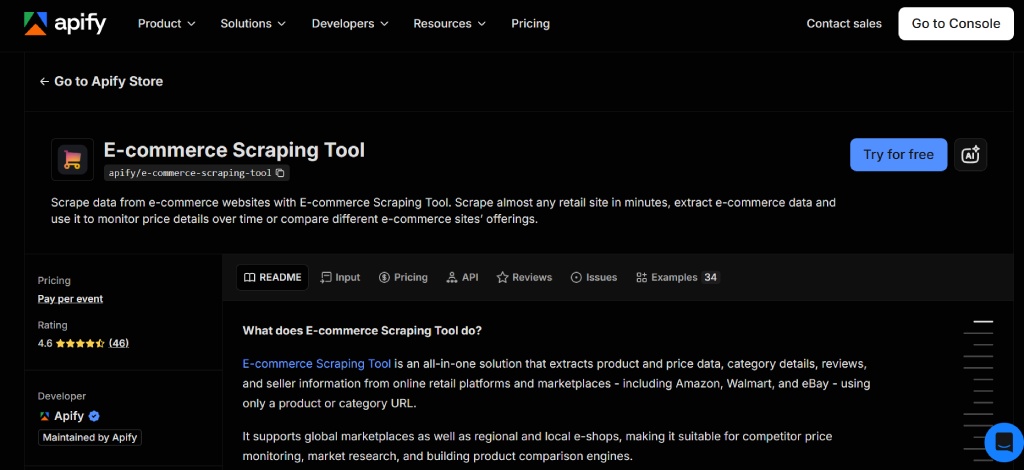
Apify is a cloud scraping platform built around serverless scrapers called Actors.
Its maintained E-commerce Scraping Tool can scrape product pages from different retail websites through one interface. Apify also offers specialized Actors for Amazon, Walmart, eBay, Google Shopping, Shopify, Etsy, and other platforms.
The main advantage is workflow flexibility. Scraping jobs can be connected to:
- REST APIs
- Python and JavaScript SDKs
- Webhooks
- Scheduled runs
- Google Sheets
- Make
- Zapier
- n8n
The maintained E-commerce Scraping Tool uses pay-per-event pricing and has a 4.6 rating from its Apify Store users. It can collect product descriptions, prices, images, currencies, IDs, and other product fields.
In the independent benchmark, Apify recorded approximately 72% overall success under standard loads. It performed well on Amazon and Best Buy but had the slowest median response time at approximately 46 seconds. For more information, read our Apify Review.
Pros:
Cons:
Choose Apify when your ecommerce scraping job must connect with automations, databases, AI agents, spreadsheets, or scheduled business workflows.
It is less suitable when you need the lowest possible response latency for individual API calls.
Output: HTML and supported structured endpoints
Starting option: 5,000 free credits; paid plans from $49 per month
ScraperAPI simplifies access to ecommerce websites by managing proxies, retries, CAPTCHA handling, browser rendering, and geographic targeting.
Instead of configuring proxy servers or running headless browsers, developers send the target product URL through ScraperAPI and receive the resulting page content.
ScraperAPI provides guides and scraping solutions for major ecommerce websites, including:
- Amazon
- Walmart
- eBay
- Etsy
- Target
- Home Depot
- Alibaba
It is easiest to use when your developers already have a parser or plan to build custom extraction rules.
ScraperAPI also offers structured endpoints for selected targets and an asynchronous DataPipeline for large scraping jobs. Its documentation includes examples for Python, Node.js, PHP, Ruby, Java, and cURL.
Pros:
Cons:
Choose ScraperAPI when you need a straightforward way to access ecommerce pages but want to control your own parsing, data validation, and storage.
It is a strong starting point for developers, but it is not the best option for teams that need completely structured datasets without additional work.
Output: HTML, screenshots, or structured JSON
Starting option: 1,000 free credits; paid plans from $49 per month
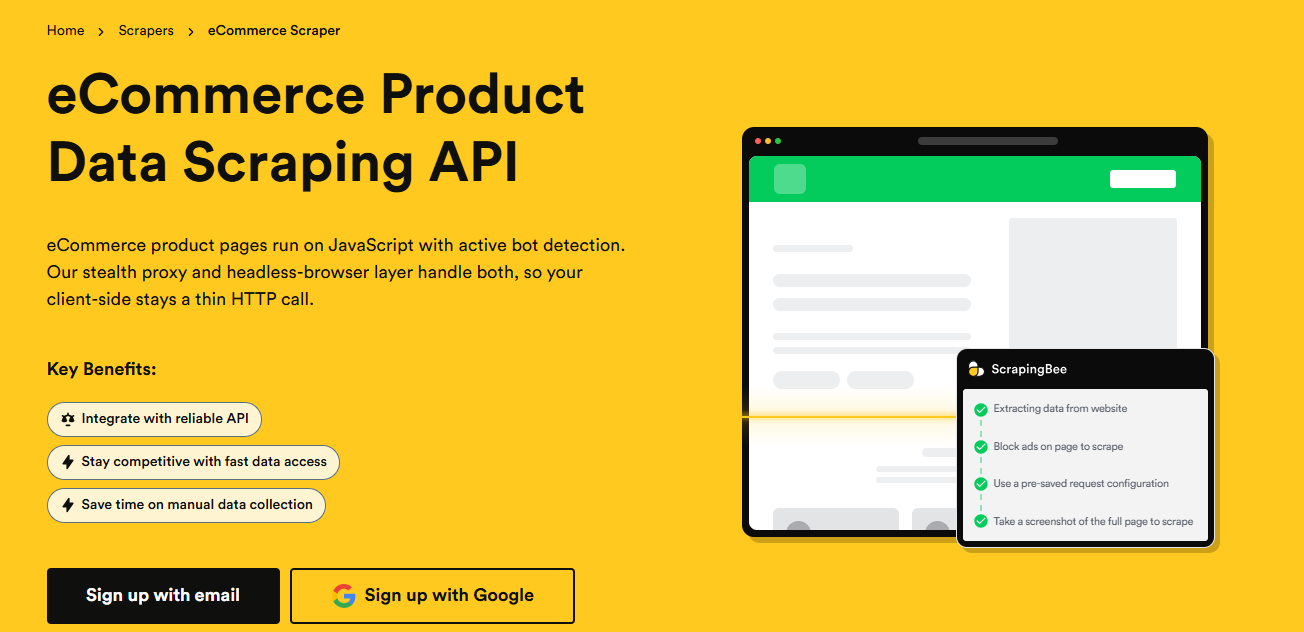
ScrapingBee is a developer-focused scraping API that manages proxies and headless browsers.
It is particularly useful for ecommerce websites that load prices, variants, stock information, reviews, or shipping details through JavaScript.
ScrapingBee supports:
- JavaScript rendering
- Premium and stealth proxies
- Geographic targeting
- Browser actions
- Screenshots
- Custom extraction rules
- AI-powered extraction
- Multiple programming-language SDKs
Developers can define traditional extraction rules or use natural-language AI extraction to return product data as structured JSON. For example, a request can ask for the product title, sale price, original price, seller, stock status, and rating without manually writing selectors.
ScrapingBee publishes SDKs for Python, Node.js, Go, PHP, Ruby, and Java.
Pros:
Cons:
Choose ScrapingBee when your target stores depend heavily on JavaScript or require browser interactions that basic HTTP scraping cannot handle.
It is best for developers who need flexibility rather than a predefined marketplace dataset.
What Is an eCommerce Scraping API?
An eCommerce scraping API is a service that programmatically collects public product and marketplace data from online stores.
You send the API a product URL, search term, category page, product identifier, or marketplace target. The provider handles the technical scraping infrastructure and returns the requested page or structured data.
Depending on the provider, the API may manage:
- Proxy rotation
- Residential IP addresses
- Browser fingerprints
- JavaScript rendering
- CAPTCHAs
- Request retries
- Rate limits
- Geographic targeting
- HTML parsing
- Data validation
- Structured JSON output
A basic scraping API normally returns HTML. A dedicated eCommerce scraping API returns product fields such as price, SKU, availability, seller, rating, and images as structured data.
How to Test an eCommerce Scraping API
Do not rely only on a provider’s advertised success rate.
Create your own representative test before purchasing a large plan.
Build a Test Dataset
Use at least 50–100 URLs covering:
- Major marketplaces
- Smaller stores
- Product pages
- Search pages
- Category pages
- In-stock products
- Out-of-stock products
- Products with variants
- JavaScript-heavy pages
- Different target countries
Define Required Fields
Create a list of fields that must be returned, such as:
- Product title
- SKU
- Price
- Currency
- Stock status
- Seller
- Rating
- Review count
- Image
- Shipping cost
A request should not count as successful when it returns HTML but fails to return the fields your business needs.
Measure Valid Success Rate
Use this calculation:
Valid success rate = Requests returning all required fields ÷ Total requests × 100
Count these as failures:
- Blocked pages
- CAPTCHA pages
- Empty responses
- Wrong products
- Missing prices
- Invalid JSON
- Duplicate results
- Incomplete required fields
Calculate Real Cost
Use this formula:
Real cost per 1,000 usable results = Total API cost ÷ Valid results × 1,000
A cheaper API can cost more in practice when it produces many failed or incomplete responses.
Measure Response Time
Record both:
- Median response time
- Slowest 10% of requests
An API may have a good average but still produce slow requests that delay an entire data pipeline.
Retest Over Time
Repeat the same test after several days.
Ecommerce websites constantly change layouts, anti-bot systems, prices, inventory, and regional behavior.
Dedicated API vs. Universal Scraping API vs. Dataset
Dedicated Ecommerce API
A dedicated API has predefined targets and product fields.
Best for: Structured product, search, pricing, or review data
Examples: Bright Data and Oxylabs
Advantages
- Faster integration
- Structured output
- Less parser maintenance
- Marketplace-specific fields
Limitations
- Only supported targets are available
- Some fields may not be customizable
- Billing may be per returned record
Universal Scraping API
A universal API retrieves almost any public web page.
Best for: Custom websites and developer-controlled parsing
Examples: Zyte, ScraperAPI, ScrapingBee, and Decodo
Advantages
- Works across more websites
- Flexible extraction logic
- Suitable for custom projects
Limitations
- May return raw HTML
- Requires custom parsers
- Costs rise for JavaScript-heavy targets
Ready-Made Dataset
A dataset contains previously collected product information.
Best for: Market research, model training, and large historical analysis
Advantages
- No scraping integration
- Immediate access to large volumes
- Can include historical data
Limitations
- May not be real time
- Limited customization
- Data may not include your exact products or stores
Is eCommerce Scraping Legal?
Ecommerce scraping is not automatically legal or illegal in every situation.
The answer depends on the jurisdiction, type of data, access method, website terms, contractual restrictions, and how the collected data is used.
In the United States, courts have distinguished accessing publicly available pages from bypassing password-protected systems under the Computer Fraud and Abuse Act. However, scraping may still create contractual, copyright, privacy, database-right, or state-law risks.
European data-protection rules can apply when scraped information contains personal data. European regulators have cautioned that web scraping involving personal information must be necessary, proportionate, and based on an appropriate legal basis.
Follow these safer practices:
- Collect only publicly accessible data
- Do not bypass logins or restricted areas
- Avoid collecting unnecessary personal information
- Review each website’s terms
- Respect intellectual-property rights
- Use reasonable request rates
- Secure the collected data
- Keep only fields required for your purpose
- Create a deletion and retention policy
- Obtain legal advice for large commercial projects
This section provides general information eCommerce Scraping legal advice.
Note: This page contains affiliate links — we may earn a commission if you buy through them, at no extra cost to you.
Frequently Asked Questions
An eCommerce API is a set of protocols, routines, and tools for building software and applications that allow data to be extracted from an eCommerce website or marketplace.
In other words, it provides a simple interface for developers to access and extract data from an eCommerce platform, such as product information, customer data, order history, and more.
The data obtained through an eCommerce API can then be used to build custom applications and integrations that can help businesses automate and streamline various processes, such as data analysis, marketing, and inventory management.
So, it is a powerful tool for businesses that want to access and analyze data from eCommerce platforms. It helps you to grow and scale your operations faster and more efficiently. Read more about benefits of using an eCommerce scraper.
Scraping eCommerce data can be challenging, but it can be much easier with the right tool. You can easily extract data from an eCommerce website using eCommerce scraper API and tools.
However, many eCommerce scraper APIs are available, so I've included the top 10 Best eCommerce Scraper APIs and Tools for 2026 in this article.
Therefore, you can easily choose one and start scraping eCommerce data. Learn more how to use an ecommerce scraper tool.
To scrape data from an eCommerce website using Python, you can follow these steps:
You will need to install Python and the libraries required for scraping, such as BeautifulSoup and Requests.
Start by identifying the eCommerce website that you want to scrape. Check the terms of service and privacy policy to ensure that scraping the website is allowed.
Inspect the website's source code to understand how the data is organized and where it can be found. You can do this by right-clicking on the website and selecting "View Page Source."
Identify the specific data you want to scrape, such as product information, pricing, reviews, etc.
Write Python code to make an HTTP request to the website, extract the HTML or XML response, and parse the data using BeautifulSoup.
Extract the desired data from the parsed response using BeautifulSoup functions, such as find(), find_all(), or select(). You may need to loop through multiple pages to get the necessary data.
Store the scraped data in a format you can use, such as a CSV or Excel file, or in a database.
So, enjoy eCommerce data scraping using Python.
No, Amazon does not allow data scraping. They have policies to prohibit scraping activities on their site, including collecting data or information through automated means such as scraping or crawling.
Attempting to scrape Amazon's site can result in legal consequences and can get your IP address banned. So it is important to always comply with a website's terms of service and to obtain permission before scraping their data.
Read more about The Legality of Using an eCommerce Scraper.
An eCommerce scraper is a tool or API that extracts publicly available data from online stores and marketplaces. This data can include product names, prices, reviews, ratings, stock availability, seller details, and more.
Instead of manually collecting information from hundreds or thousands of product pages, eCommerce scrapers automate the process and deliver structured data that businesses can analyze or integrate into their systems.
Summary
With eCommerce continuing to grow, it’s important for businesses to stay ahead of the curve. So you must need an excellent eCommerce Scraping tool.
That’s why I’ve listed the top 10 best eCommerce scraper APIs and tools in this details review. With these tools and APIs, you can easily scrape data from various sources to gain valuable insights about your customers or competitors.
With this information, you can develop better marketing campaigns, optimize product prices more effectively, and stay one step ahead of the competition.
So, choose one according to your requirements and boost your eCommerce business. Learn more how to choose the best e-commerce scraper for business .

