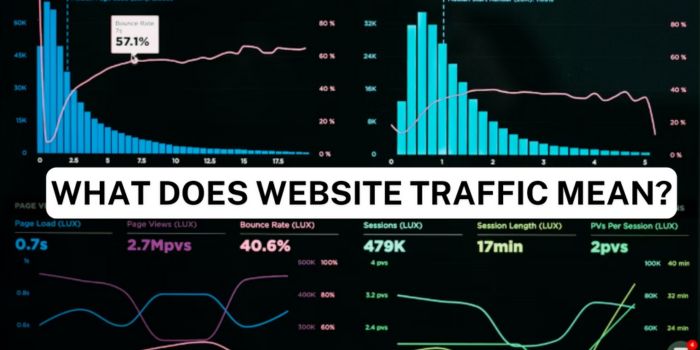
Website traffic means the visitors who come to your site — every click, every page view, every person who lands on your blog or store. It's measured in metrics like sessions, unique visitors, and pageviews.
For a small site, getting 1,000 to 15,000 visitors per month is typical, and the goal isn't just more traffic — it's the right traffic from people who actually care about what you offer.
When I started my first blog, I checked Google Analytics every morning hoping to see the numbers move. Most days, they didn't. And when they finally did, I realized something important: I had no idea what those numbers actually meant.
If that's where you are right now, this guide is for you. I'll break down what website traffic really means, why it matters, what's "good," and how to grow it — using the same metrics I track on my own sites and for clients today.
What Is Website Traffic, Really?
Think of your website like a small shop. Every person who walks in is a visitor. Some browse, some buy, some leave. Website traffic is just the digital version of that foot traffic — except instead of a doorbell, you have Google Analytics.
In technical terms, website traffic refers to the total number of visitors and visits your website receives over a given period. Each time someone lands on a page, it counts. Each time they come back, that counts too.
Here's a quick reality check most beginners don't hear:
90.63% of web pages get zero organic traffic from search engines (Ahrefs, 2023). If your site is new and quiet, you're not broken — you're just normal.
- A typical local business gets around 414 users and 506 sessions per month (BrightLocal).
- The biggest sites get billions. Google itself had 168.7 billion visits in December 2023 (Semrush).
So when you're staring at 47 visitors this month, remember: most pages get nothing. You're already ahead.
Why Website Traffic Matters
Traffic is the fuel for everything else online — sales, sign-ups, ad revenue, brand awareness. Without it, the prettiest website in the world is just a parked car.
Here's why it matters in plain terms:
More visitors mean more opportunities. If 100 people visit your site and 10% buy, that's 10 sales. If 1,000 visit, same 10% conversion gets you 100 sales. The funnel works the same way — you just need more bodies in it.
It improves your search rankings. Google rewards popular sites with higher placement. And higher placement gets more clicks. Position #1 on Google captures roughly 33% of clicks, while position #10 gets less than 2%. Once you're climbing, the climb gets easier.
It builds your brand. Even visitors who don't buy today remember you. The more eyes on your site, the more chances you create for someone to come back later, recommend you, or finally pull the trigger on something you sell.
How Website Traffic Actually Works
The flow is simpler than people make it out to be:
Discovery Someone finds you via Google, social media, ads, or a link on another site.
Click
They click through to your site.
Interaction
They read, browse, buy, sign up, or leave.
Your job is to make steps 2 and 3 worth their time. That's it. Everything else — SEO, ads, content marketing — is just a way to feed step 1.
The 6 Types of Website Traffic
Not all traffic is the same. Knowing where yours comes from is how you figure out what's working. Most websites see traffic split roughly like this:
Source | % of total traffic | Source | % of total traffic |
|---|---|---|---|
Direct | 22% | 14% | |
Organic search | Organic search | Display ads | 12% |
Organic search | 17% | Referral | 9% |
Social | 16% | Paid search | 9% |
Organic traffic comes from search engines like Google. Someone types a question, your blog post answers it, they click. This is the gold standard — free, sustainable, and high-intent. Build for this if you have time.
Paid traffic comes from ads — Google Ads, Facebook Ads, sponsored posts. You pay, they click. Faster than organic, but stops the moment your budget runs out.
Direct traffic is when someone types your URL straight into the browser. Strong direct traffic usually means strong brand recognition.
Referral traffic comes from links on other websites. A blog mentions you, their readers click through. Great for credibility and SEO.
Social traffic comes from Instagram, Facebook, LinkedIn, TikTok, and X. Variable in quality, but excellent for visibility.
Email traffic comes from your newsletter and email campaigns. Highest conversion rates of any channel — if you have a list, use it.
What's a Good Amount of Traffic?
This is the question every beginner asks, and the honest answer is: it depends. But here's the data from a HubSpot survey of over 400 web traffic analysts that gives you real benchmarks:
Monthly visitors | % of websites |
|---|---|
1,001 – 15,000 | 46% |
15,001 – 50,000 | 19.3% |
50,001 – 250,000 | 23.2% |
250,001 – 10M | 11% |
10M+ | 0.5% |
Almost half of all websites sit between 1,000 and 15,000 visitors per month. If that's where you are, you're not behind — you're average. And average is a fine place to start.
A few patterns from the same data worth knowing:
- Older sites win. Most websites that hit 250,000+ monthly visitors are over 10 years old. Time compounds.
- Mobile dominates. 41% of visits come from phones, 38% from desktop, 19% from tablets. Your site has to work on a small screen.
- Publishing more helps. Sites that publish multiple times a day are far more likely to break the 10M visitor mark.
How to Measure Website Traffic
You can't grow what you don't measure. Here are the metrics I check first on any site:
- Sessions — Number of visits in a time period.
- Unique visitors — How many distinct people came (one person can have multiple sessions).
- Pageviews — Total pages loaded.
- Session duration — How long visitors stayed.
- Bounce rate — % who left after viewing one page. Healthy range: 21–40%.
- Click-through rate (CTR) — % who clicked your link in search. Healthy range: 10–39%.
- Conversion rate — % who took your goal action. Typical range: 2–5%.
Google Analytics 4 — Free, powerful, and the industry standard. Sign up, install the tracking code, and wait 24–48 hours for data. Once it's set up, check Reports → Acquisition → Traffic Acquisition to see where visitors come from.
Semrush or Ahrefs — Paid, but worth it once you're serious. They show which keywords drive your traffic, what your competitors rank for, and where you can win.
How to Increase Website Traffic (What Actually Works)
After a decade of testing, these are the moves that consistently produce results:
Use the right keywords. Pick search terms your audience actually types. Tools like Google Keyword Planner help you find them. Add your main keyword to the title, URL, and naturally throughout the content — but never stuff it.
Publish content that solves problems. "How to pick the best running shoes" beats "Our company is great" every time. Answer real questions and Google rewards you.
Make your site fast. Every extra second of load time bleeds visitors. Run your site through Google PageSpeed Insights and fix what it flags.
Build email subscribers. A newsletter is the only traffic channel you fully own. Algorithm changes can't take it from you.
Be active on social media. Pick one or two platforms where your audience already hangs out and post consistently. Don't try to be everywhere.
Earn backlinks. Other websites linking to yours signals to Google that you're trustworthy. Guest posts, partnerships, and genuinely good content all earn links.
Run paid ads carefully. Start small ($15–$50), test what works, then scale up. Don't blow your budget without data.
Make it mobile-friendly. With 41% of traffic on phones, your site has to work flawlessly on small screens.
When Buying Traffic Makes Sense
Organic SEO works, but it's slow. If you need to test an offer, validate a niche, or get visitors today, buying targeted traffic can shorten the timeline.
Need real visitors today?
I deliver Tier 1 email-based solo ads traffic from real people in the US, UK, Canada, Australia, and New Zealand — pre-qualified for affiliate, MLM, and biz-opp niches. Free funnel review and satisfaction guarantee included.
Final Thoughts
Website traffic isn't just a number — it's the heartbeat of your online business. But more isn't always better. What matters is getting the right visitors: people who actually want what you offer, stick around to engage, and come back later.
Start by measuring where you are. Pick one or two channels to focus on. Publish consistently, optimize for mobile, and watch your numbers slowly climb. The compounding takes longer than you'd like — but if you stick with it, the curve always turns.
That's how every site I've grown got there, and it's how yours will too.
Frequently Asked Questions
The fastest paths are paid ads (Google Ads, Facebook Ads), solo ads, or social media campaigns. Organic SEO takes 3–6 months to show real results, so paid options work better when you need traffic now. Just budget carefully — start with $15–$50 to test what works before scaling.
Traffic with strong engagement signals (long session duration, low bounce rate, return visitors) tells Google your site is valuable. Higher rankings then bring more traffic, which feeds the cycle. Note that raw visitor count alone doesn't help — engagement quality is what moves rankings.
Yes, but it's a bad idea. Fake traffic from bots inflates your numbers without bringing real conversions. Worse, Google can detect it and penalize your site. If you're buying traffic, only use vendors who deliver real human visitors with engagement guarantees.
Most websites convert at 2–5%. E-commerce stores often run 1–3%, while well-optimized landing pages can hit 10–15%. If yours is below 1%, the issue is usually your offer, copy, or page design — not your traffic.
A unique visitor is one person. A session is one visit. The same person visiting your site three times equals 1 unique visitor and 3 sessions. Both numbers matter — visitors show audience size, sessions show engagement frequency.
Make your page load faster, write compelling intros that hook readers, add internal links to keep them clicking, and make sure your content actually matches what they searched for. A bounce rate of 21–40% is healthy. Above 60% means something's wrong on the page.
Because 41% of all web visits now happen on phones. If your site is slow or hard to use on mobile, you're losing nearly half your potential audience instantly. Use a responsive theme and test your site on a real phone — not just a desktop browser preview.