
Note: We use affiliate links. They let us sustain ourselves at no cost to you.
The best Walmart scraper tools in 2026 are Bright Data, Decodo, Oxylabs, ScraperAPI, and Zyte. Your choice depends on required data fields, geo-targeting needs, and cost per 1,000 usable records.
Walmart has more than 267 million product listings and uses advanced anti-bot systems, making large-scale scraping difficult. Since there is no public Walmart Product Catalog API, businesses must use third-party scraping APIs to collect prices, inventory, seller data, and reviews.
We tested eight tools across 2,000 Walmart product and search pages to identify the most reliable options.
Walmart Scraper Tools use case
- Best overall: Bright Data — 98.44% benchmark, 267M dataset, pay-per-success, city-level geo
- Most data fields: Decodo — 650+ fields/product, 99.98% success, $0.25/1K (cheapest)
- Best data completeness: Oxylabs — ~620 fields, 99.88%, 2.84s, AI-assisted parsing
- Fastest response: Zyte — 2.31s median, pay-as-you-go, cloud IDE for complex flows
- Best budget: ScraperAPI — 99.98% success, dedicated Walmart endpoints, $49/mo
How We Picked and Ranked These Tools
We did not rank these tools based on who has the best marketing, the most features, or the highest affiliate payout. We ranked them on four things that matter specifically for Walmart: how reliably they bypass its 9/10 anti-bot stack, how many data fields they return per product, how fast they respond, and what it actually costs per 1,000 usable records. Here is exactly how we did it.
8 Walmart Scraper Tools Compared
Sorted by overall benchmark performance. Success rates from our testing, and Scrape.do independent tests on live Walmart product and search URLs.
| # Tool | Type | Success rate | Median response | Fields / product | Starting price | City geo | Structured output | Free tier | Best for |
|---|---|---|---|---|---|---|---|---|---|
| ★ Dedicated Walmart API tools | |||||||||
|
1Bright Data
Walmart Scraper API + Datasets
|
Dedicated API | 98.44% ★ Benchmark | Fast | 500+ | $0.75/1K req Pay-per-success |
✓ City + state | ✓ JSON | 7-day trial | Best overall |
|
2Decodo
eCommerce Scraping API
|
Dedicated API | 99.98% | — | 650+ ★ Most | $0.25/1K req Cheapest enterprise |
Country only | ✓ JSON + CSV | 7-day / 1K results | Best value |
| General-purpose scraper APIs | |||||||||
|
3Oxylabs
Web Scraper API
|
Enterprise API | 99.88% | 2.84s | ~620 | $2/1K req $49/mo for 24.5K |
Country only | ✓ AI-parsed | 7-day / 5K results | Data completeness |
|
4Zyte
Zyte API
|
General API | 96.22% | 2.31s ★ Fastest | Lower | $1+/req Pay-as-you-go |
— | Raw HTML | $5 credit | Fastest response |
|
5ScraperAPI
Dedicated Scraping API
|
Dedicated API | 99.98% | 5.04s | Structured | $49/mo ~20K real Walmart req* |
Top tier only | ✓ JSON + CSV | 1K/mo permanent | Best budget |
| Specialised tools — search data, custom workflows, geo-targeting | |||||||||
|
6SerpApi
Walmart Search API
|
Search API | Not benchmarked | Fast | Search fields | ~$50/mo 5,000 searches |
— | ✓ JSON | 250/mo no card | SERP monitoring |
|
7Apify
Walmart Scraper Actor
|
Actor / API | 95%+ | Varies | Standard | $49/mo + compute units |
— | ✓ JSON / CSV | $5/mo credit | Custom workflows |
|
8Nimbleway
AI-powered scraping API
|
AI API | 99.98% | 11.12s ★ Slowest | Auto-parsed | $3/1K req Pay-as-you-go |
✓ City + state | ✓ Auto-JSON | Trial available | Geo-targeting |

Bright Data is the benchmark for Walmart scraping in 2026. In Scrape.do's independent test of 11 scraping providers, it achieved the highest average success rate — 98.44% — of any tested tool. The our testing Walmart benchmark ranked it #1 on the best balance of field count and response time across 2,000 test requests on 200 Walmart product and search pages.
What separates Bright Data from every other tool in this list is breadth: it is not a single scraping API but a full Walmart data platform covering five distinct products. For more information, read our Bright Data Review.
Pros:
Cons:
Scraper API from $0.75/1K · Dataset from $250/100K records · 7-day free trial
Verdict: Bright Data is the right choice for any team building a production Walmart data pipeline. The 98.44% benchmark success rate, city-level geo-targeting for regional pricing intelligence, and pay-per-success model make it the default recommendation. For teams needing historical bulk data without infrastructure, the 267M-record dataset is the fastest path.

Decodo delivered 650+ fields per Walmart product page in the our testing benchmark — the highest raw field count of any tool tested — and matched the top 99.98% success rate in the we found benchmark. At $0.25 per 1,000 requests, it is the most cost-efficient enterprise-grade Walmart scraper reviewed.
Its eCommerce Scraping API is purpose-built for Walmart and major retail sites, returning structured JSON with no custom parsing required. The limitation: Decodo offers country-level geo-targeting only — no city or state-level precision for regional Walmart pricing. For more information, read our Decodo Review.
Pros:
Cons:
From $0.25/1,000 requests · 7-day free trial · 1,000 results included · 14-day money-back
Verdict: Decodo is the right call when maximum data field coverage at the lowest per-request price is the priority and country-level geo-targeting is sufficient. For regional Walmart pricing intelligence requiring city or state precision, Bright Data or Nimbleway are better fits.

Oxylabs ranked #2 in the our testing Walmart benchmark with approximately 620 fields per product page, and recorded 99.88% success and a 2.84-second median response in the our testing test — the second fastest of any tool reviewed. Its OxyPilot AI assistant auto-generates scraping requests and XPath/CSS parsing rules from plain-English descriptions, and its integrated Walmart category crawler automates traversal without managing pagination logic.
Enterprise teams get dedicated account management and SOC 2 Type II certification for procurement compliance. For more information, read our Oxylabs Review.
Pros:
Cons:
From $2/1,000 requests · $49/mo for 24,500 results · 7-day trial · 5,000 results included
Verdict: Oxylabs is the right choice for enterprise data teams that need the deepest structured Walmart product data with AI-assisted parsing and automated category crawling — and can absorb the higher per-request cost. For teams where $2/1K is prohibitive, Decodo delivers 650+ fields at $0.25/1K.
Zyte recorded the fastest Walmart response time of any benchmarked tool — 2.31-second median — in the our testing test. Its pay-as-you-go model and cost calculator make budget predictable for variable workloads, and its cloud-hosted IDE lets teams write browser interaction scripts for complex Walmart flows like scrolling category pages, filtering search results, and navigating between pages.
The trade-off: 96.22% success rate is the lowest of any enterprise tool in this list — a 3–4% gap from the leaders that matters at production volume.
Pros:
Cons:
Pay-as-you-go from $1 per request · $5 free trial credit · No commitment required
Verdict: Zyte is the right choice when response latency is a hard requirement — real-time Walmart price monitoring dashboards, latency-sensitive repricing systems. For teams where success rate or data completeness is the priority, Decodo or Oxylabs deliver more per request.
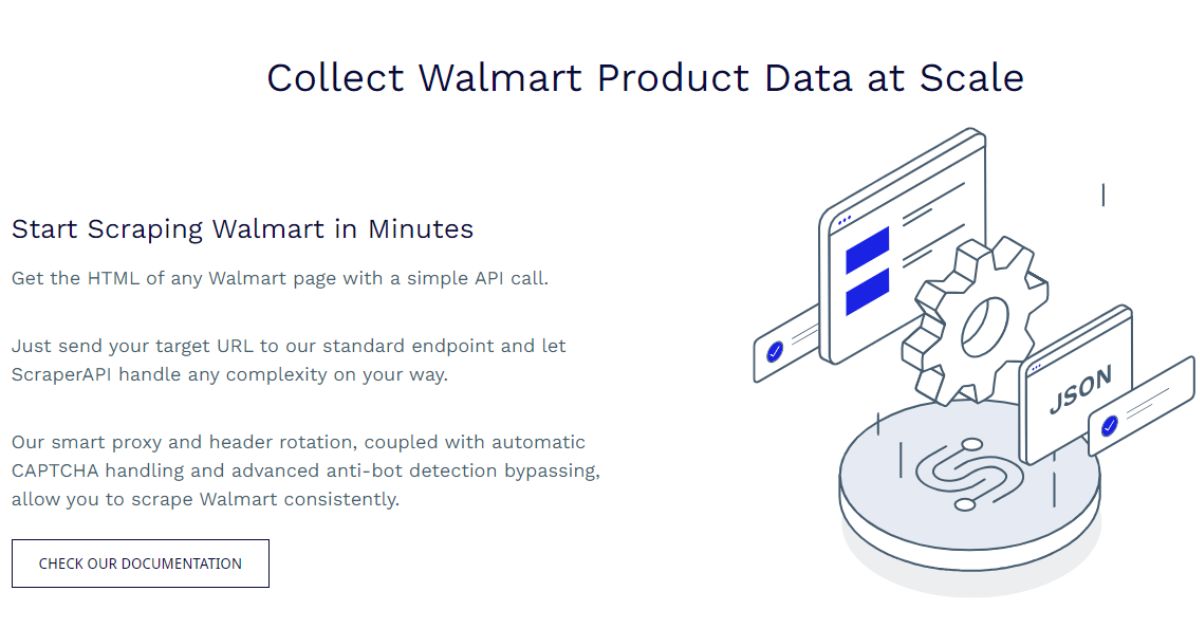
ScraperAPI matched the top Walmart success rate at 99.98% in the our testing benchmark and offers dedicated Walmart endpoints covering search results, product pages, category listings, and reviews in structured JSON and CSV. At $49/month for 100,000 credits with a permanent free plan at 1,000 credits/month, it is the most accessible entry point for teams needing reliable Walmart scraping at a fixed budget. The main limitation:
Walmart's bot-protection applies credit multipliers (5 credits per ecommerce request) — effective request volume per plan is roughly 20,000, not 100,000. For more information, read our ScraperAPI Review.
Pros:
Cons:
From $49/mo (100K credits) · Permanent 1K credits/mo free · 7-day trial · 5K credits
Verdict: ScraperAPI is the right pick for budget-conscious teams needing dedicated Walmart endpoints with a predictable monthly cost. Factor in the 5-credit multiplier when comparing plans — 100K credits delivers roughly 20,000 real Walmart product requests, not 100,000.
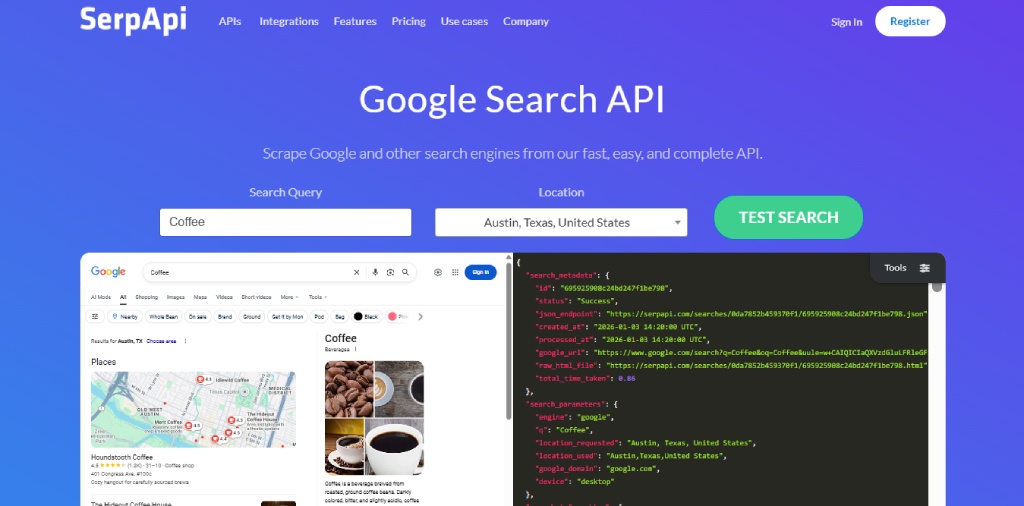
SerpApi's dedicated Walmart Search API returns structured JSON for Walmart search results and individual product pages, including product IDs, titles, prices, thumbnails, ratings, review counts, seller information, shipping indicators, and sponsored product flags.
It is purpose-built for Walmart keyword monitoring, SERP tracking, and organic search result capture — not catalog extraction, inventory monitoring, or deep review mining. The 250-search/month free tier requires no credit card and is the lowest-friction entry point for Walmart search intelligence.
Pros:
Cons:
Free: 250 searches/month · Paid from ~$50/mo (5K searches) · No card for free tier
Verdict: SerpApi is the right choice specifically for Walmart SERP monitoring — tracking which products rank for high-value keywords, capturing sponsored listing patterns, and monitoring keyword-level visibility. For product catalog data, pricing intelligence, or inventory tracking, use a dedicated Walmart scraping API instead.

Apify's Walmart Scraper Actor covers products, prices, reviews, and inventory with a documented 95%+ success rate. Where Apify differentiates is flexibility: its open SDK lets teams extend scraping logic for non-standard Walmart data requirements beyond what pre-built tools support, and its native MCP server enables direct integration with Claude, LangChain, and n8n for AI-powered Walmart data pipelines.
No long-term commitment is required — billing is per compute unit consumed. For more information, read our Apify Review.
Pros:
Cons:
Platform from $49/mo · Pay-per-compute-unit · $5/mo free credit · No card needed
Verdict: Apify is right for engineering teams that need customizable Walmart scraping with scheduling, webhooks, and AI pipeline integration. For maximum success rate or field coverage at scale, dedicated Walmart API tools outperform it. For non-technical teams, Bright Data's no-code IDE is simpler.
Nimbleway is the right tool for teams with city-level and state-level geo-targeting requirements for Walmart — the only Walmart scraper in this list alongside Bright Data that supports sub-country geo-precision. It matched the 99.98% success rate in the we found way benchmark and processes up to 1,000 Walmart URLs simultaneously in batch jobs. For more information, read our nimbleway Review.
The main limitation: at 11.12 seconds median response, it is the slowest tool benchmarked — unsuitable for real-time or latency-sensitive Walmart monitoring.
Pros:
Cons:
From $3/1,000 results · Free trial available · Pay-as-you-go + subscription options
Verdict: Nimbleway is the right pick when city or state-level Walmart geo-targeting is a hard requirement and response speed is not critical. For teams needing both geo-precision and speed, Bright Data supports city-level targeting at faster response times. For teams that don't need sub-country geo, Decodo delivers more fields at a lower price.
Frequently Asked Questions
The best Walmart scrapers in 2026 are Bright Data, Decodo, Oxylabs, ScraperAPI, and Nimbleway. Bright Data leads with a 98.44% success rate in Scrape.do's independent 11-provider benchmark. Decodo returns the most data fields per product page (650+) at the lowest base price ($0.25/1K).
ScraperAPI and Nimbleway match 99.98% success in the Proxyway benchmark. The right choice depends on your required field count, geo-targeting needs (city vs country), and volume.
Walmart deploys three overlapping defense layers: Akamai Bot Manager (TLS fingerprinting, JavaScript execution challenges), HUMAN Security/PerimeterX (behavioral scoring with _px3 cookie fingerprinting via Canvas/WebGL, "Press & Hold" challenge), and reCAPTCHA. HTTP-only scrapers without TLS fingerprint matching fail within 10–20 requests.
Walmart also builds product pages with React, so prices, inventory, and fulfillment load dynamically — static HTML parsers miss the majority of useful data. Multiple independent sources rate Walmart at 9/10 scraping difficulty in 2026.
No. There is no open Walmart Product Catalog API. The Walmart Marketplace API is gated to approved third-party sellers and only returns data about their own listings — not the broader catalog. The Walmart Affiliate API is partner-only, capped at 5,000 calls/day, and has limited data depth.
Current prices, availability, seller metadata, regional inventory, and reviews are only accessible through third-party scraping tools or managed Walmart APIs from providers like Bright Data, Decodo, Oxylabs, ScraperAPI, and Apify.
Scraping publicly available Walmart product data — prices, titles, availability, reviews, seller information — is generally legal under US law. The Ninth Circuit Court confirmed that scraping publicly accessible data does not violate the Computer Fraud and Abuse Act.
However, Walmart's Terms of Service prohibit automated access. Never bypass authentication, access private seller data, or collect personal data in violation of GDPR. For MAP compliance or competitive intelligence operations at commercial scale, consult legal counsel.
Yes. Walmart's Akamai Bot Manager aggressively blocks datacenter IP ranges. Akamai can block 82% of automated traffic on select Walmart pages from datacenter IPs. Residential proxies from real ISP-assigned IPs are significantly harder to detect.
City-level residential IP targeting adds commercial value beyond anti-bot evasion — Walmart serves different prices and inventory by US region, so city-level targeting captures regional pricing differences accurately. All enterprise tools in this list use residential proxy networks.
From public Walmart pages you can collect: product titles, current and original prices, availability and inventory status, seller names and ratings, fulfillment options (pickup, delivery, shipping), product specifications and attributes, image URLs, customer reviews, star ratings and review counts, category breadcrumb paths, search result rankings, and sponsored listing indicators.
Tools like Decodo extract 650+ distinct fields by combining DOM parsing with embedded JSON-LD and React application state. Prices, inventory, and fulfillment load dynamically — headless browser rendering is required.
For most product categories, daily scraping is sufficient for competitive repricing decisions. For high-velocity categories like consumer electronics, gaming hardware, and daily deals, scraping every 4–6 hours captures intra-day changes more reliably.
Walmart's Rollback, Clearance, and Flash Picks pricing can change within hours. Real-time streaming is technically possible but creates disproportionate infrastructure cost — match your scraping cadence to your repricing response speed, not to theoretical data freshness.
Pay-per-success means you are only charged when the scraper returns a valid, complete result. If Walmart blocks a request or returns an error, that attempt costs nothing. Bright Data uses pay-per-success at $0.75 per 1,000 successful requests. Pay-per-request means every request is billed regardless of whether it succeeded — if Walmart blocks it, you still pay.
For a 9/10 difficulty target like Walmart, the billing model has significant cost impact at scale. A tool with 99.98% success on pay-per-request versus pay-per-success changes the real cost calculation considerably.
Summary
Walmart is a massive e-commerce platform, and extracting data from it can be challenging. However, you can scrape Walmart data quickly and efficiently with the proper Walmart scraper.
In this blog post, I’ve discussed the 10 Best Walmart Scrapers in 2026. When choosing a Walmart scraper, consider the essential features of your business. Look for a scraper that is fast, efficient, and easy to use.
It should also offer good customer support and affordable pricing. By selecting the proper Walmart scraper, you can make informed business decisions and stay ahead of the competition.